Friday, 31 January 2014

Brake On Me


Brakes are handy things on vehicles. Millions of us put our utmost faith in them, our very lives, every time we climb into a car or board a bus. Most of us don’t break into a clammy sweat as we accelerate above 20mph with the nagging fear that nothing will happen when the brake pedal is depressed. A lot of very clever engineers and some very risk-averse quality assurance managers over the last ten decades have made brakes so utterly and tediously reliable that we don’t give them a second thought. And so we hurtle around in our metal boxes, staying alive only through a heady mix of engineering guile, our own instinctive reactions, and luck.

Of course if we think about brake failure at all, we think of the worst kind - the brakes not engaging when required. This is the type of brake failure depicted in many Hollywood films of a certain genre, with shots of the driver’s foot stamping on the pedal cutting to shots of their horrified face as the edge of the cliff approaches. Seldom do we concern ourselves with the second-worst type of failure of a braking system, which is when the brakes decide all by themselves to engage when NOT required. I’m not aware of this scenario ever having been dramatised (although it’s possible that the car Kit in the 80’s TV series Knight Rider may have occasionally decided to jam on the brakes by itself for some very good reason.)

So when this exact thing happened to me on Tuesday evening as I drove the minibus home from an outing to Dorchester cinema to watch Twelve Years A Slave, I was momentarily taken aback. We were pootling along a dark country lane at 40mph when all of a sudden the vehicle was braking hard all by itself. I was able to bring it safely to a stop after several seconds of bemused deceleration, engine still running. It appeared to be the handbrake that had engaged, not the regular brakes. The handbrake lever was rendered useless - it would not even pull up.  The back two wheels were held fast by their drum-brakes.

It was good fortune that we had been on a straight section of a quiet lane, only four miles from home. Had it occurred fifteen minutes earlier we would still have been on the A35, a mostly single-lane, winding and hilly trunk road. 


The AA was called, as was Pilsdon’s rescue service (a.k.a. Craig in the Citroen Berlingo) to collect the rest of the passengers leaving Clive and I to await the AA. The incredible usefulness of mobile phones was duly noted. By bashing the back wheels with a heavy object we had managed to loosen the drum brakes so we could park the bus at the side of the lane and let the occasional car past, but we thought the burning smell was an indication that we shouldn’t attempt to drive it all the way back. 

Forty-five minutes later an alien spaceship descended on us, covered in red lights, and two bright tractor beams switched on to draw our vehicle up the ramp which had unfurled. Out of a door which opened up in its side stepped a figure, which wobbled its way towards us and introduced itself as Alan.  We said hi. Alan tied the minibus wheels to his truck, we climbed into the cab and off we drove back to Pilsdon, somehow negotiating the thirty-six foot-long beast down twisting lanes which were no wider than it. I then had to reverse the minibus back off the ramp taking care not to slip off either side, and it was done. Home safe and not a single casualty. Alan vanished into the night leaving only an A4 carbon copy of a rescue service form to prove his existence.

The bus was fixed the very next day by Pilsdon Autos across the way but I have yet to hear what precisely had gone wrong and how it has been rectified. For my own peace of mind I hope to find out the details before I get behind the wheel again. 

Friday, 24 January 2014

The Eco-Woodlanders

The most recent dwelling at Tinkers Bubble, still under construction inside

In a week when the EU set itself a target by the year 2030 of reducing carbon emissions to 60% of what they were in 1990, and producing 27% of its energy from renewable sources by the same date, I visited a community in Somerset who have already reduced their carbon emissions to 0%* and produce 100% of their energy from renewable sources. 

The thatched roundhouse used for communal meals and just chilling out

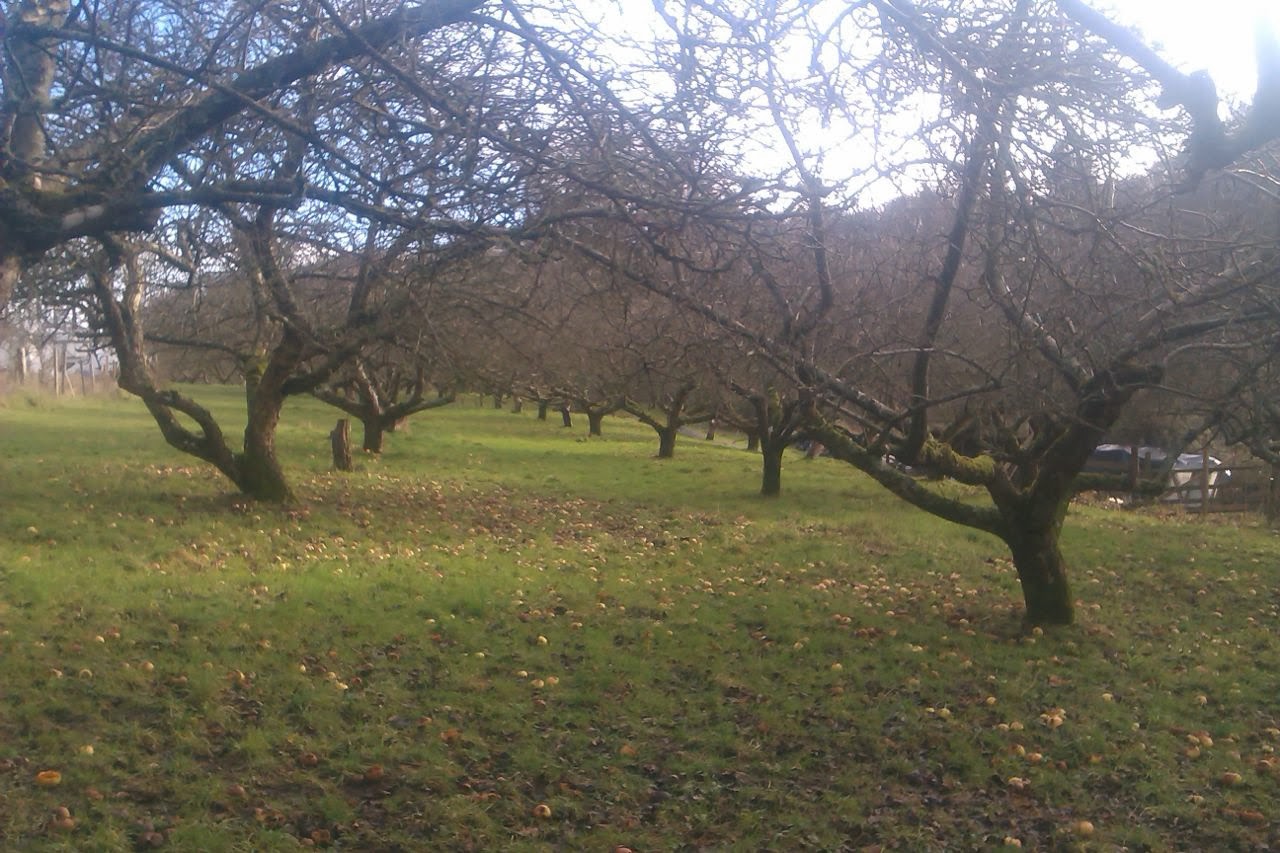
Twelve adults and three children are living in a forty acre wood some miles west of Yeovil. They make a living from producing organic apple juice from their orchards, growing and selling veg to the surrounding villages, and producing and selling timber from the larch and Douglas fir that forms their habitat.  There is a strict “no fossil fuel” policy on site, so no chainsaws, no diesel generators, no propane gas for cooking or heating, no heavy machinery for extracting felled trees.  All the buildings are made from their own timber. Water is supplied from a spring called Tinkers Bubble, after which the community have named themselves. The dwellings are wired for 12V electrics provided by a few solar panels and a small wind turbine. From wood comes the energy for heating and cooking (often from the same wood-burning stove). Two-handed saws and axes are used for felling trees, handsaws for cross-cutting them and mauls for splitting them. And how do they move the felled trees? Two beautiful black and white cart-horses, who are also being trained to pull ploughs.

Dolly the cart-horse showing off her 80's hair-do

I was visiting my friends Paula** and Nic who had moved in last summer and are expecting their first child in May. Their residence is a small canvas-covered structure on the edge of the woodland with a great view across the valley beyond.  Despite not looking much from the outside, stepping indoors I found a warm ambience with colourful wall hangings, books everywhere, a solid-looking double bed and a large south facing window. The wood-burning stove certainly helped too, which we stoked to fry some potatoes on for lunch.

Just one of their orchards. They juiced over twenty tonnes of apples last year

They spoke of the joys and challenges of living like this. Two hours a week washing clothes manually using three large buckets and a mangle initially felt like a massive chore but has since become just part of their domestic routine. Evenings meals are communal so they only have to cook once every twelve days. Especially during winter, collecting and chopping firewood has become second nature. I helped Nic move a hefty three-foot length of a mature Douglas fir, which the recent storms had blown down, to the doorway of their house where we dug a shallow hole and erected it as a chopping block to replace his old one which had fallen to bits from use. We then fetched three timber poles, six foot long and one foot wide, from the other side of the woodland, each one resting on our shoulders, and hewed and split them into the right sizes for their stove. Afterwards we were so warm we didn’t need to light it!

The steam-driven timber-processing machinery was jaw-dropping

The fact that other children live here gave them confidence that bringing up their own newborn amongst the trees will be possible. Washing reusable nappies by hand outdoors is doable. A neighbour gave Paula a bulging bag of baby clothes. A former resident who was visiting told her that two of her four had been born here and she couldn’t think of a better place for them to grow up, far from the normal trappings of modern life - the shopping centre, television, the internet, the adverts everywhere you look.

Short-legged Dexter cows can graze safely amongst the low-hanging apple trees

As the light faded I made my way down the hill to where my fossil-fuel-powered vehicle was parked. It seemed bizarrely high-tech as I slid into the driver’s seat, switched on the ignition without needing to light a match, and drove the seventeen miles back to Pilsdon in just over half an hour. There’s no denying that burning fossil fuels make life convenient, and dare I say it, interesting (without the car I probably wouldn’t have visited.) And yet it messes with the planet’s climate to a dangerous degree. If only our governments actually had the will to initiate massive switch-over programmes to 100% renewable energy sources (as described by the Zero Carbon Britain report).  We could all be driving electric cars by 2030, powered by a grid fed principally by hundreds of offshore wind farms, topped up by synthetic-gas stations. Well, it’s a dream.


*OK so they do burn wood which gives off carbon dioxide but it is only the carbon dioxide that the tree absorbed during its lifetime, so in effect this is carbon-neutral energy.


**Names changed as usual.

Friday, 17 January 2014

Race For The Prize

Ice on the glasshouse window on Tuesday morning forming gorgeous fern-like patterns

Pilsdon seems to have caught the competition bug. Whenever I glance at the announcements blackboard it has either an upcoming tournament calling for players or the current state of play of some ongoing challenge. So far it’s been limited to table tennis, darts, snooker and pool, but once we’ve tired of these indoor sports we’ll no doubt soon progress onto mud-wrestling, caber-throwing and morris dancing. In that order. Without a change of clothes.

Going into the snooker tournament I carried an unjustifiably heavy burden of expectation on my shoulders as this time last year I had somehow emerged victorious as snooker champion. This time however there are new residents who can actually play the game, and so I crashed and burned in the first round to the eventual second-placed finalist, who generously shared round his prize of a big box of Quality Street (though not the tobacco which came sellotaped to the lid). The competition winner received a trophy which all agreed looked nice but sadly couldn’t be consumed.

The competitive spirit has even entered the genteel Common Room, normally a place of fireside chats and tinkling piano. On Wednesday night I found myself there teaching the card game Canasta to eager participants who then proceeded to beat me and my partner which just goes to show how much luck is involved in the game. Although, as I pointed out the next day, there was no winner as we ended the game before they had reached 5000 points. Anyone who knows Canasta will attest to the fact that scores can swing wildly towards the latter end of a game. (Hmm, that competitive spirit seems to have infected me too.) Teaching the rules was made more lively by the fact that Wendy*, another volunteer, had been brought up playing a vastly different variant of Canasta which was apparently unique to her family, and yet every time I explained a rule that differed from her version she would exclaim in astonishment at how much easier and therefore less fun this game was than hers, and point out how the rules differed thus bewildering the poor learners.

Jenny, Roger and me. Can you guess which is which?
You might think that the gentle art of making marmalade was immune from any such bitter rivalry but not so here.  Last week we had bought a large crate of Seville oranges for this very purpose and so on Monday I recruited Jenny, Roger and Cyrus to help me make a big batch using 12lb of the oranges. That was too much for one pot so we split into teams of two, one pot each, and thus the competition began. Barbed comments were made about the thickness of the other’s peel-cutting. Later after the two pots of golden liquid had been poured into forty jam jars, there were jibes about how ours were setting better than theirs. There was even a hotly contested wager over the spelling of the word “marmalade” (Jenny was terribly upset when the dictionary revealed it is not spelled “marmelade”, and as punishment had to write it out correctly on forty labels). The end result however was entirely delicious. 


There was only one thing which could unite us and that was potatoes. It being Potato Day recently in Bridport, Pilsdon’s garden team made a special trip. Seed potatoes of many hues, shapes and personalities were on display in colour-coded buckets on trestle tables, behind which lurked the potato experts, doling out free advice to all and sundry. I fought through the crowds and bought ten Arran Pilot and ten Majestic for planting on my plot in Wales, while others selected different cultivars for planting at Pilsdon. Here at last we were united in our common love of the humble potato. Although once they’re planted I’m sure there’ll be a certain amount of friendly banter over how well each other’s spuds are sprouting.

Ice like stylised waves on a turbulent sea

*All names made up in this post.

Friday, 10 January 2014

Sweet Child O'Theirs


River at breakfast

There are not many circumstances in early 21st century life which afford the chance to witness every day the slow maturing and growth of a human infant, short of having your own. And the parents of young children are of course biased, not to mention sleep-deprived and frazzled from the unending battle of wills.  Nursery and primary school teachers only tend to spend a year with each set of little rascals.

Having a younger sibling is one way of seeing a child grow but often the age gap isn’t great. I was twelve years old when my brother was born so I can remember a fair amount about how the tiny ball of screaming unfolded slowly into a walking talking person, but of course I was far from being an adult myself.

Living in a community with a baby must be one of the very few other ways in our society that it is possible to see such a miraculous transformation day by day, over the months and years. I had been at Pilsdon just two months when River was born, in May 2012.  If you track back far enough in this blog you will find it happening. He is now nearly twenty months old and has acquired a vast range of skills, along with a fine mop of blond hair and a cheeky grin. Not only can he walk, he can climb onto a low table and wobble perilously until someone catches him. He has quickly learned the art of making his desires extremely clear and will brook no argument until they are fulfilled, no matter how inconvenient or arbitrary they may seem to everyone else.

Tricky to catch River being still enough for a photo

Conversationally River is at the single repeated word stage, but he understands a lot more than he can say. Ask him “Where’s your eye?” (which to someone learning English must sound like a single word “Warezyoray”) and he points at one of his eyes. When his mum told him that they would be visiting his favourite friend “this afternoon or tomorrow” he burst into tears at the injustice of not being able to go RIGHT NOW.  And when I ask him what makes honey, he beams and replies “Bee!”, at which I pretend my finger is a buzzing bee coming to land on his nose. (As I taught him this fact, it gives me a kick to keep checking he knows it.)

Honey, or “Nummy” as he calls it, is one of his two favourite things, the other being tractors. It’s got to the point that we try to hide the honey jar behind other condiments on the breakfast table but this rarely stops him from demanding Nummy as soon as he is carried into the dining room. I fear for whoever first tries reading him the story of Pooh Bear and the honey pot, as he is not going to allow it to continue without the provision of his own honey supply.

From a very early age River has clearly been the active and rambunctious sort. Not for him sitting still quietly playing with bricks. He loves interacting with people, and at Pilsdon he’s got plenty of us to choose from. On a recent short break in Devon with his mum and dad, he apparently kept repeating “pee-pol”. He wanted to be back amongst the adoring masses. It’s true, everyone has a soft spot for him, it’s impossible not to. He is just so cute. And yet if he remembers something he wants or if he detects that something is being denied him, he can switch from angel to screaming blue murder in an instant. At this point he is smartly handed back to his parents.


River has chosen new names for many of us - I am “Nangyan” for a reason yet unknown (is it my name in Mandarin?), Peter is “Teper”, Lillian is “Ninny”, Michael is “Googol”. He has yet to wrap his mouth around three-syllable names such as Carolyn or Jonathan but when he does he will no doubt improve them in some way. Hopefully the names will stick.  

As I am planning to live in Wales from March I will be missing out on his turning into a Terrible Two and the ensuing fun. I can only hope that when I return, perhaps this wintertime, he will recognise me, smile, point at me and say "Nangyan!" 


River a few days old

(Note: Parental permission obtained for this blogpost.)

Friday, 3 January 2014

The Lion Sleeps Tonight


An ice sculpture I made 

We walked into the inky blackness of the vegetable garden leaving the lights of the house behind us and set the telescope down where the paths converged. Up above us the heavens glittered. As our eyes adjusted, the scene above became less black, more silver, as the fainter stars became visible and the long blur of the Milky Way appeared. I oriented the scope towards the planet Jupiter, the brightest object visible. The only sound was the whirr of the electric motor as I centred the small ‘finder scope’ on it, then a few fine adjustments to locate it in the middle of the main viewfinder. The greenish globe jerked into view, and as the others took their first peek there were gasps of awe. We could see the bands that bisect it, but the “red spot” (actually a swirling age-old storm bigger than the Earth) must have been on the other side. Four of its moons, no more than bright dots, formed a line, three on one side of Jupiter, one on the other. The largest of them, Ganymede, is bigger than the planet Mercury. Scientists in the 1600’s made their first crude measurement of the speed of light using these moons.

Recently planet Earth completed another revolution of the Sun, or it did if you happen to follow the Gregorian calendar. (The Chinese have to wait another 28 days before they get to celebrate the first day of the Year of the Horse). It’s customary at Pilsdon to celebrate this event with a candle-lit three course dinner, after which everyone gathers in the Common Room for The Quiz and an open revue session of song, dance, games and spoken word leading up to the midnight fireworks. It’s probably similar to how the Victorians had fun, with no TV or radio, and everyone offering something to entertain the group. That analogy perhaps gives the impression of a rather worthy but joyless occasion, whereas in fact the opposite was true. We were in high spirits, and all without a drop of alcohol!

A Penguin

Alcohol was in more plentiful evidence at the nearby Monkton Wyld community the previous evening (not that I could partake as I was returning to Pilsdon the same night). By a huge shiny dollop of coincidence, a large group from Machynlleth, mid-Wales, had decided to come all the way down to Monkton Wyld for a few days - and I knew some of them well from my sojourn in Wales this year.  So I was invited along to their animal-themed fancy dress birthday party.  I had no costume but realised that I could just shake out my mane and it was immediately obvious what I was. Some face-paint daubing later and I was a bona fide lion ready to mingle with the penguins, tigers, fish, dragonflies and amoeba (I was tasked with painting the amoeba’s face... not an easy commission, I’m sure you would agree.)

A Fish


Over the next two days, four of my friends from the group came to visit me at Pilsdon and were given the grand tour of the site, a welcome opportunity to show them my winter home and chat about plans for next year. It was good to be able to link for the first time my Welsh world with my Dorset one. And somehow the thought of returning to my caravan in March seems less daunting now - I have friends up there waiting for me to return.

Friday, 27 December 2013

'Tis The Season To Wear Cardies

A Christmas selfie
It isn’t often that one’s vocabulary is challenged and broadened by a Christmas jumper. Often the only challenge such a gift can provide is how to remain convincing whilst affirming how much you like it (not the case this time as I actually do rather like this natty black and white cardigan - thanks Mum!) but concealed within this one is a small white label whose red text reads: “DUE TO THE NATURAL STRUCTURE OF THE KNIT A CERTAIN DEGREE OF PILLING WILL OCCUR”. 

This left me a little nonplussed. Was it a typo, and they meant “PILING”? If so what was going to pile onto what? Would I be crushed? I suppose it would depend on exactly how heavy “A CERTAIN DEGREE OF PILING” would be. A little more accuracy wouldn’t have gone amiss.  But if not a typo, then what does it mean to "PILL"? Surely it can’t refer to the consumption of the little medicinal capsules we are so prone to lobbing down our gullets at the slightest head-twinge or gut-gripe? It was hard to see how the structure of my jumper could affect the quantity of paracetamol I’m about to consume.

A quick internet search put me right. It means “BOBBLING”, a word that presumably didn’t carry enough gravitas with whoever it is whose job it is at the fine company of Bench to come up with the warning label messages. I am guessing that this is someone different from the person who was able to write “Music and laughter is the lifeblood of our consumers, and us too” in the ‘About Us’ section of the Bench website. I imagine that that person would choose the word BOBBLE over PILL.  

Along with millions of others, I spent this Christmas with my family, up north. To be clear, my family did not have millions of people stay over. The millions all went to be with their respective families, in-laws and out-laws, and that’s just as well really as it would have been difficult to get everyone to agree which channel to watch. In fact we seemed to spend more time playing miniature table-tennis than watching TV, which in our minds at least helped to offset the heavy calorie intake and got the adrenalin pumping almost as much as a good bout of University Challenge.

Pilsdon's Christmas tree in the Common Room

If it’s the season to be merry, it’s also the season to be thankful, and I am profoundly grateful to have both a loving family, and a warm and welcoming home in the shape of the Pilsdon community.  There are many who have neither. 

If you needed a reason for Pilsdon to exist, you need look no further than the two young guys who turned up here separately last Friday. Both had come to a crisis in their lives and both could easily have ended up on the streets during the horrific weather of the last few days, had they not been referred to Pilsdon by social services. 

Initially they were offered a weekend which was then extended to the full Christmas week, and both of them are now applying to become residential guests as they realised how much a sojourn at Pilsdon, removed from the temptations of drugs or alcohol, could help them put their lives back together.   It certainly puts my pilling worries into perspective.

Friday, 20 December 2013

The Great Indoors

After the uproar inadvertently caused by my blogpost last week which prompted an unprecedented number of comments (three plus my replies, so far), I feel I ought to tone it down a bit today and steer clear of any potentially hazardous topics or who knows, I might jeapordise my very existence at Pilsdon. One of the tree-hugger lobby might decide they’ve had enough and decide to do something they might regret (or worse, not regret). Besides, I have had a request from a faithful French follower of this blog to expand on the subject of Pilsdon’s glasshouses which, if I can steer clear of any mention of the three birch trees that are growing dangerously close to the back of the large one, should be pretty safe ground. Here goes.

Broad beans and lettuce in the large polytunnel
Pilsdon is well endowed with indoor growing space. There’s the large glasshouse (40' by 16') which featured in last week’s notorious blogpost, and next to it is the big polytunnel (50' by 20') which a whole team of us re-skinned, re-doored, and laid down concrete paths in the spring of 2012. Tucked away on the other side of the orchard is another polytunnel (65' by 12'), narrower but longer than the first, and then there are two small greenhouses which we use for raising seedlings until they are ready to be ‘transplanted’ into the soil somewhere (either outside or in a polytunnel/glasshouse). Seedlings are often started off in one of two electrically-heated germination cabinets in the potting shed; we use nine or twelve-celled plastic trays filled with sieved peat-free compost from the local garden centre and carefully (or recklessly, depending on who’s doing it) pop a seed in each cell.


Garlic and broad beans in the big glasshouse

Stuff we only tend to grow indoors: tomatoes, aubergines, sweet peppers, chilli peppers, i.e the real warmth-lovers. And stuff we normally grow both indoors and out in the fresh air: cucumbers, courgettes, french beans, runner beans, squash, pumpkins, beetroot, carrots, and more.  We have recently tried melons and okra in the polytunnel but neither were a great success. 

After harvesting, all the soil indoors has manure or compost dumped on it and dug in - Pilsdon is fortunate in having a constant supply of muck from our cows and pigs that we let rot down over a year or so.

Another view of the glasshouse - the dormant vines just visible at the back


Each year we plan what goes where. To keep things simple, what gets sown in the large glasshouse and polytunnel are simply switched each year as they are both of similar size. So in 2013 the large polytunnel had the french & runner beans, garlic, squash, cucumbers, okra and beetroot while the large glasshouse had the tomatoes, aubergines, peppers and early potatoes. This two-year rotation hinders any veg-specific diseases building up in the soil, although normally a three or four year rotation is recommended (we practice a four-year rotation in our four main outdoor beds). The glasshouse also has two beautiful one-year-old grapevines at the back, one for white grapes and the other red, whose recent brush with death for the sake of a couple of trees is dealt with elsewhere. Bill sows whatever he feels like in the other polytunnel.

It also pays to squeeze in an extra harvest in the spring by sowing indoors in the autumn - the extra warmth and shelter allows some veg to grow successfully throughout the winter. So in April and May this year Pilsdon were eating loads of delicious fresh broad beans, cabbages, cauliflower and spinach that I’d sown the previous September (I missed out on eating them by moving to Wales in April, sadly). The over-wintered broccoli and beetroot didn’t yield so much.  This autumn we were a bit late but even so we have serried ranks of broad bean plants pushing their way into glory, three stately rows of garlic, some directly-sown spinach poking their noses up and in the small greenhouse some young cauliflower (27) and cabbage (36) in celltrays, not mature enough to go in yet.

The 'small' polytunnel, currently with green manure growing (field beans and mustard) that will be dug in to improve the soil
None of our greenhouses or polytunnels are heated. In the depths of last winter I had to prop most of the broad bean plants up with sticks as they were flopping over in the bitter cold, but they all survived. 

Winter is a good time to carry out those maintenance tasks that are so easy to put off. The concrete floor in the big polytunnel allows easy sweeping and a cleansing with water. The big glasshouse windows need a good clean with a long-handled mop (ours has a jet attachment to direct water on at the same time). Any broken panes are replaced (we had a couple blow out from a small greenhouse during last month’s big storm). Rips in polytunnel plastic are taped up. I’ve heard of people fumigating their greenhouses with a sulphur candle to kill all fungal and bacterial nasties but that’s generally not an option for us as there’s always some crop or other in there.

Now to sit back and wait for all the angry comments to flood in from those offended by the idea of killing fungi...